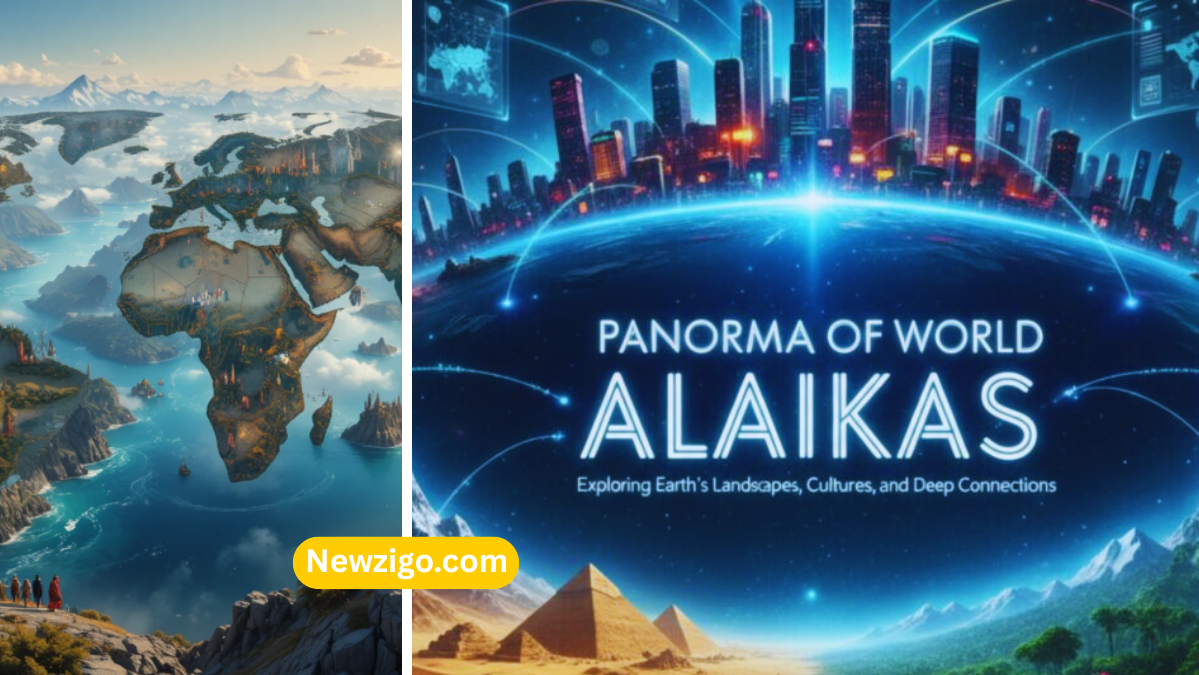
panorama of world alaikasThe phrase “Panorama of World Alaikas” might sound mysterious, even poetic at first. But it really captures a wide-angle perspective of our world — one that looks beyond individual countries, cultures, or landmarks and instead focuses on what connects us all: culture, history, landscapes, ideas, and identity. This panoramic view isn’t just about seeing more; it’s about understanding better — noticing how all the threads of humanity weave into a beautiful, broad picture.
In a world often divided by borders and differences, the Panorama of World Alaikas invites us to zoom out and appreciate humanity as a whole — diverse yet connected, unique yet united. Let’s explore this concept from multiple angles to get a fuller sense of what it means and why it matters today.
What Does “Panorama of World Alaikas” Mean?
Breaking it down, the phrase has two main parts: panorama and alaikas. The word panorama suggests a “complete view,” encouraging a perspective that’s wide, inclusive, and holistic. Applied to the world, it urges us to see Earth not as isolated pieces, but as a continuous, interconnected whole.
The term alaikas is less defined in mainstream dictionaries but is understood as a symbol of distinctive cultural phenomena, traditions, and expressions that hold significance across societies. It’s less about a fixed definition and more about capturing the essence of human experience — the elements that define us and how we live.
Together, the Panorama of World Alaikas becomes a metaphor for seeing everything at once — cultures, landscapes, traditions, histories, and contemporary identities — as one living, breathing tapestry.
The Geographic and Natural Panorama
To see the world panoramically, we must first consider its physical foundation. Geography shapes life itself — influencing climate, biodiversity, settlement patterns, and culture.
Our Earth consists of diverse landscapes: towering mountains, vast deserts, dense forests, sprawling plains, and icy polar regions. Each environment affects how humans live, the food they eat, the architecture they build, and even the stories they tell. The natural world is not a backdrop; it’s a major player in humanity’s story.
For instance, civilizations often thrived near rivers: the Nile in Egypt, the Tigris and Euphrates in Mesopotamia, and the Indus in South Asia. The geography of these regions shaped agriculture, trade, and social organization, leaving lasting legacies that continue to influence life today.
Cultural Panorama: How Traditions Shape Us
Culture is the beating heart of the Panorama of World Alaikas. It encompasses languages, rituals, music, art, and social identity, reflecting the creativity and values of different societies.
With over 7,000 languages spoken worldwide, each carries unique perspectives on life. While many languages face extinction, they each reveal a distinct worldview and offer insight into the ways communities solve problems, celebrate milestones, and preserve knowledge.
Consider festivals around the world: India’s Holi, Japan’s Cherry Blossom celebrations, or Mexico’s Día de los Muertos. Each one reflects symbolic meanings unique to its culture. These expressions are alaikas — distinct markers that, together, form a global mosaic of human creativity and identity. Even everyday traditions, from cooking styles to clothing, carry deep cultural significance.
Historical Panorama: The Threads of Time
History binds the panoramic view together. Empires rise and fall, trade routes spread ideas, and innovations travel across continents. Understanding history in this broad sense allows us to see not just events but patterns and connections.
Ancient civilizations like Mesopotamia, Egypt, and the Indus Valley set the foundation for human progress. The Middle Ages expanded cultural and scientific exchange across continents. The Industrial Revolution and modern globalization have connected humanity more tightly than ever before.
The Panorama of World Alaikas reminds us that history is not only dates and battles; it is the story of how people, ideas, and traditions influence one another over centuries, forming the intricate fabric of human experience.
Social and Human Panorama
The social aspect of the world panorama covers education, health, economy, migration, and equality. These elements illustrate both the challenges and triumphs of humanity.
While disparities exist, the panoramic view shows shared human aspirations for dignity, well-being, and opportunity. Social issues, whether local or global, are better understood when viewed from this broader perspective. It encourages empathy, cooperation, and a recognition that we are all part of the same human story.
This view also highlights the resilience of societies. From grassroots movements to international cooperation, humans continuously seek solutions to problems, demonstrating creativity, solidarity, and innovation.
The Modern Panorama: Technology, Innovation, and Identity
In today’s world, technology adds a new dimension to the panoramic view. Instant communication, digital networks, and innovations in science and energy connect billions of people in unprecedented ways.
Technological advancements become new alaikas — symbols of human ingenuity. They reshape culture, identity, and interaction, creating a dynamic, evolving global society. Digital media allows local traditions to reach worldwide audiences, and languages once limited to small communities can thrive in new contexts.
This modern panorama blends the traditional with the contemporary. It reminds us that identity is fluid and that human expression evolves while maintaining ties to historical and cultural roots.
Why the Panorama of World Alaikas Matters Today
In a world often defined by division, the Panorama of World Alaikas encourages broad, inclusive thinking. It allows us to appreciate differences while recognizing shared humanity.
Through this perspective, we learn to respect cultures, traditions, and experiences without erasing uniqueness. We see challenges, from climate change to inequality, as collective issues that require cooperation. By stepping back, we gain a richer understanding of the human journey.
Ultimately, the panorama is not just poetic — it’s practical. It helps us navigate complexity, find connection, and appreciate the global mosaic of human life.
Conclusion
The Panorama of World Alaikas is more than a phrase; it’s a mindset. It invites us to look at life with curiosity, empathy, and openness. It urges us to connect ideas, experiences, and traditions, forming a holistic view of humanity.
In a rapidly changing world, this panoramic perspective is invaluable. It allows us to see the beauty in diversity, the lessons in history, and the promise of collaboration. By embracing this wide view, we experience a world that is interconnected, vibrant, and infinitely fascinating.